

Key Takeaways
- Rejection in digital marketing is inevitable and often tied to business decisions—not personal shortcomings—so learning to process it without overreacting is key to long-term success.
- Emotional resilience comes from allowing yourself to feel disappointment, seeking constructive feedback, and practicing strategies like lateral thinking to turn “no” into new opportunities.
- A strong support network helps you recover faster, maintain perspective, and avoid letting setbacks derail your confidence or productivity.
We’re canceling our services with Crunchy Links and moving to another agency. We believe this will help our business grow faster.
That was the gist of the email from an online banking FinTech client in 2022. There was no warning that the client was unhappy with our agency—it was just an out-of-the-blue email exercising their right to terminate the contract.
I was angry. The founders of the online bank signed with us because I was on the executive team. They wanted my insights because they were “looking to work with underserved communities” and thought I’d provide expert ideas and strategies on how to do that.
Less than a year later, they were leaving for a more prominent agency. Of course, I went and looked up the new agency.
Not a single face on their “About Us” page was from the underserved communities this bank wanted to work with.
I was doubly angry at that point. For months afterward, I would check the former client’s website, looking for any updates, and judging what the new marketing agency was doing for them.
It took up a lot of mental real estate and made me miserable.
The fact is, I had no right to be pissed. We put the walk clause in our contracts because clients should be able to move freely from one agency to the next or move marketing in-house.
I was upset because I felt lied to, but even that shouldn’t have mattered. I needed more resilience to rejection.
I needed more resilience to hearing the word “no.”
We’re gonna talk about how to build that resilience as a digital marketer.
Here’s the TL;DR
- Understanding Rejection
- Common Digital Marketing Rejection Scenarios
- Strategies for Handling Rejection
- Conclusion
Our first step is to understand rejection and its impact on us.
Understanding Rejection
According to a PNAS meta-analysis of previous studies by Ethan Kross, Marc G. Berman, Walter Mischel, and Tor D. Wager, we have evidence that our bodies react to emotional pain the same way they react to physical pain: “[t]his whole-brain analysis indicated that both types of experiences led to overlapping increases in activity in affective pain regions found in previous studies…”
What does all that mean? In simpler terms, when we’re rejected, our brains literally process it as physical injury (which explains why every rejection felt like a gut punch to me). And, like with all physical and emotional pain, we experience several stress reactions:
- Increased Heart Rate and Blood Pressure
- Rapid Breathing
- Muscle Tension
- Sweating
- Release of Glucose (we release glucose from liver storage to provide energy)
- Increased Alertness and Focus (stress hormones sharpen senses and focus attention on the perceived threat)
This biological reality means our intense reactions to rejection aren’t a sign of weakness. They’re hardwired human responses to a stress reaction, and rejection causes a stress reaction.
Before we talk about ways to manage our reaction to rejections, though, let’s talk about some of the potential rejections marketers face.
Common Digital Marketing Rejection Scenarios
Why is it important to handle rejection? Because stress impacts our businesses. According to the American Institute of Stress:
- Employers lose $183 billion per year due to decreased employee productivity
- Job stress is estimated to cost the US industry $300 billion in losses annually
- 40% of job turnover is due to stress
Managing our stress responses better will help us as digital marketers.
Client pitches
We spend time running an audit, analyzing the findings, and compiling a captivating pitch deck. We schedule the meeting with the potential client and walk them through our presentation.
After that, we’re no longer in control. It’s up to the potential client to choose our pitch over all the others they’re considering.
I remember one client pitch that went so smoothly, I figured the client would sign the contract ASAP.
WRONG!
The client wrote back the next day, asking for a discount on our monthly retainer. We told the client we don’t offer discounts.
We went back and forth for a few weeks, the client asking for different variations of a discount, and us telling them our pricing is final.
Finally, the client decided not to work with our agency. Our decision not to discount our pricing caused the client to reject our services.
After weeks of back-and-forth, their final ‘no’ stung more than the initial pricing objection. I felt like I’d failed to demonstrate our value.
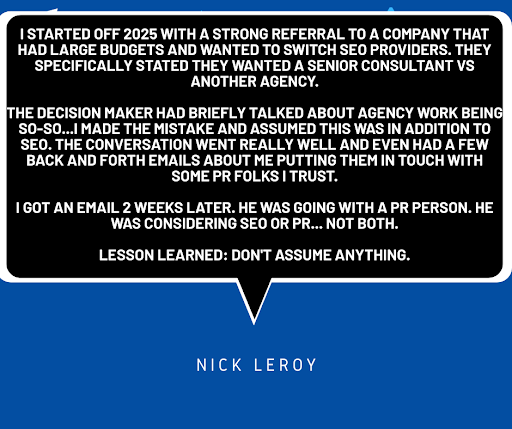
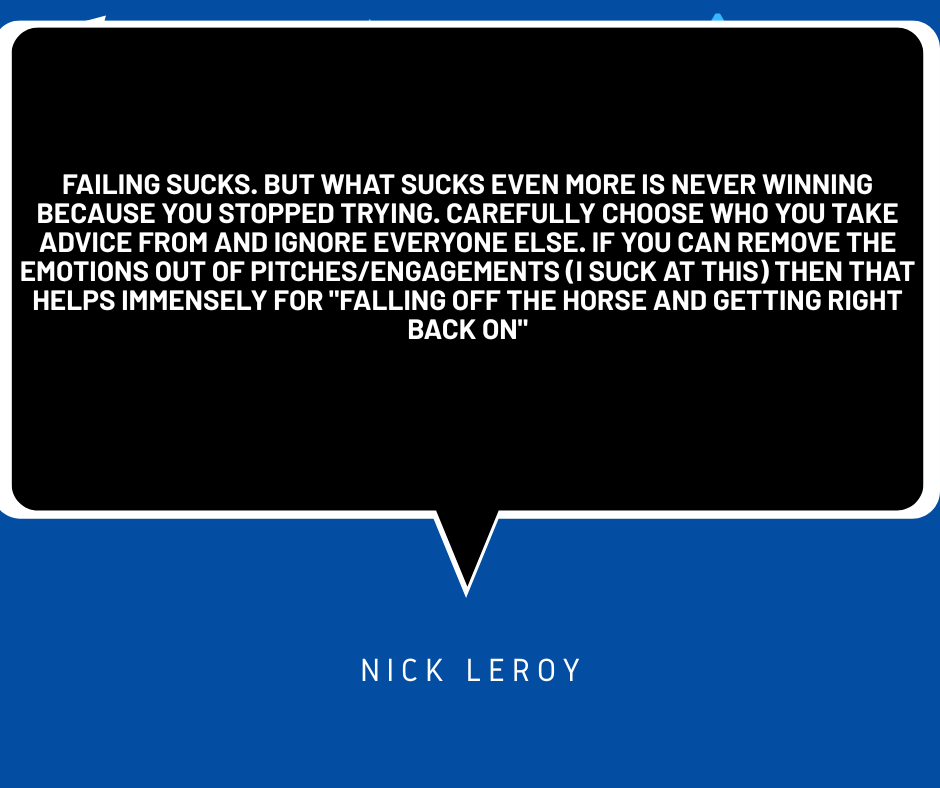
Digital marketing professional Nick LeRoy shared an experience where he faced rejection after a client pitch:
Client pitches are breeding grounds for rejection.
Campaign proposals
Once you’ve won the client, it’s time to pitch them strategies. You haven’t lived until a client has told you your marketing plan won’t work because “that’s not how we do things around here.”
When I worked for a lead generation company, they wanted a campaign proposal that would help their education vertical generate more leads for clients. I pitched that we conduct interviews with school deans, administrators, professors, and other staff and get expert testimony content. Since our for-profit education partners refused to provide any of their professionals, I also pitched that we speak to other schools.
I was told that a former employee tried doing interview content, and that the content didn’t work.
Refusing to take “no” for an answer, two co-workers and I found interview subjects, conducted the interviews, transcribed the audio to text, and wrote five sample articles to show our bosses.
They loved our work and asked that we replicate the idea across several of their education-based websites.
Content ideas
During the early stages of working with a FinTech client, I submitted thirty content ideas for approval. I needed my contact to choose five pieces to write for the next month, and to mark any ideas they didn’t want to use. Surviving ideas would go on a list for writing and publishing later.
My contact rejected all thirty ideas.
Privately, I crashed out. Professionally, I did more research and found five additional content ideas my contact would approve. This contact would be fired a month later, and we’d get approval on the other thirty ideas I submitted. But, in the moment, the rejection hurt.
I never found out why the contact hated the ideas I submitted. All I know is, by staying calm, I won.
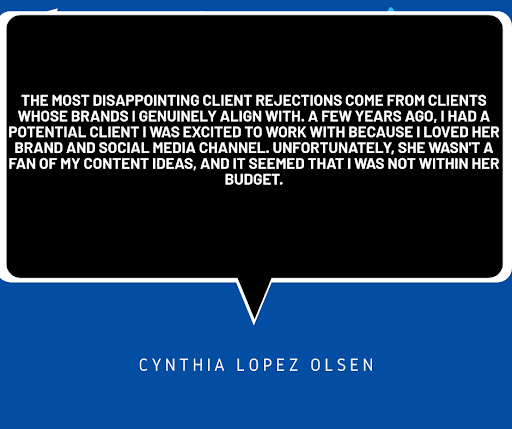
Another marketer, Cynthia Lopez, shared her experience with me:
Budget requests
Sometimes, we need to ask a client for additional budget for a marketing campaign. Nick has a great example of a time when asking for more budget resulted in rejection:
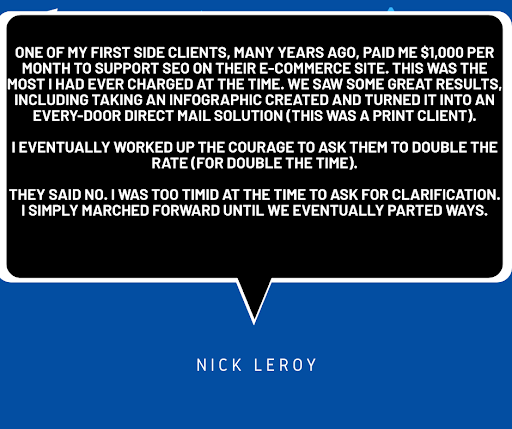
Asking for money can be uncomfortable and may result in rejection.
Strategies for Handling Rejection
If you read my article, “Stress and Stressability: Working on Emotional Regulation,” you’ll recognize some of the strategies I suggest for handling rejection. The two are related: having good emotional regulation allows us to manage and control the stress of rejection. Becoming resilient gives us the capacity to bounce back from that rejection. Learning emotional regulation skills can boost our resilience.
Let’s examine some strategies for handling rejection.
Allowing ourselves to feel disappointed
We’re allowed to feel the disappointment of rejection. We’re allowed to feel the anger of rejection. We have to feel all the feelings, because there’s a physical danger in hiding those negative emotions: “Indeed, in several studies now, measures of the inhibition of negative emotions have been found to predict all-cause mortality as well as the incidence of coronary heart disease, hypertension, and related risk factors…”(Emotional Expression and Health: Advances in Theory, Assessment and Clinical Applications).
When stressed, “[t]here is a decrease in blood flow and oxygen to the brain, which promotes lower cognitive functioning and sends the brain into a chaotic state. In this state, the brain is unable to access the information it needs to make logical decisions (Walden University).” The more this happens, and the more we suppress our emotions, the more likely we are to blow up at a coworker, a manager, or a client.
We need to be the opposite of Cal Naughton, Jr in Talladega Nights:
Ricky Bobby: Hey, Cal, I’m sorry about wrecking you today. I mean, but that was for the team.
Cal Naughton, Jr: No, that’s cool. That’s cool, I know. You know, I was thinking, though, one time it would be really awesome if, like, you could slingshot me in for a win.
Ricky Bobby: Yeah, but…Okay, but if you won, how am I gonna win? Think about it.
Cal Naughton, Jr: No, I was thinking about it.
Ricky Bobby: I mean, it’s not like you’re finishing 18th.
Cal Naughton, Jr: There’s nothing wrong with silver.
Ricky Bobby: Nothing wrong with silver at all.
Cal Naughton, Jr: I’m just kidding you, man. I don’t wanna win. I’ll just bury it down inside.
Ricky Bobby: Bury it deep down in there, and never bring it up again.
Cal Naughton, Jr: It’s painful, and I love you!
Don’t bury your emotions. It’s okay to allow ourselves to feel the full disappointment. Because if we don’t, we might lash out. And that is a worse outcome than feeling badly about rejection.
Avoid knee-jerk reactions
Holding onto our emotions can damage our mental health and our close, personal relationships. Lashing out, though, can damage our client relationships.
If we damage our client relationships, we damage our company’s revenue stream. We don’t want that.
We should sit with that email response until we’re calm. Or, at least, calm enough not to tell the recipient to *bleep* off.
We can avoid knee-jerk reactions by remembering the following:
Rejection isn’t personal
I was angry about the client leaving Crunchy Links because I took it personally. However, the decision had nothing to do with me. It was about them going with an agency they felt would help them build their business quicker than our smaller agency.
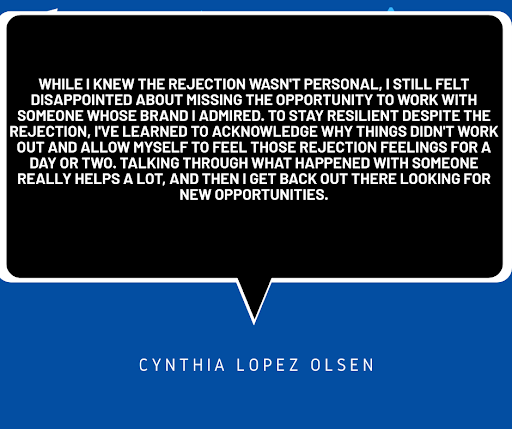
Cynthia shared a moment when she had to remember that rejection wasn’t personal:
Most marketing decisions aren’t personal; they’re about objective business decisions.
Rejection can be based on objective marketing decisions
March 2020 was a horrible month. Two Enterprise-level clients canceled their contracts with Crunchy Links due to the COVID-19 outbreak. We lost ~60% of our monthly recurring revenue.
There wasn’t a single solution to the problem that we could have instituted to prevent those clients from canceling their contracts with us.
Rejection can also be based on subjective factors
One of our PPC clients decided to cancel their work with us and move it in-house. It wasn’t because our strategies were unsuccessful. It was because, to paraphrase our point of contact, they felt they could duplicate our work and save money by letting us go.
Seek constructive feedback
We can be our best cheerleaders and our worst critics. It’s rare, however, that we see ourselves perfectly. That’s why we need a team of friends and family who can provide constructive feedback.
Being willing to seek out feedback is a superpower. It means that our egos are strong enough to handle constructive criticism.
Develop lateral thinking
When my partners and I started Crunchy Links, we didn’t have funding. We didn’t have huge savings accounts to buy all the shiny tech we needed. We purchased what tools we could, but still needed to build our internal processes and external reporting suite.
We went low-tech as hell, cobbling together what we needed from existing sources. We found free online templates. We built our own from examples we used at different jobs.
Our reports weren’t pretty, but our clients didn’t give a damn. They wanted the results.
Little did we know that we were using lateral thinking to solve our issue.
What’s lateral thinking?
Lateral thinking is using “seemingly disparate concepts or domains that can give old ideas new uses.”
In his book Range, David Epstein talks about how, in the 1960s, Nintendo engineer Gunpei Yokoi used “lateral thinking with withered technology” to create products for the company.
Yokoi was a limited engineer, but used lateral thinking to come up with ideas. He knew that, by using older technology that was well-known and inexpensive, he could find and market unexplored uses for those technologies.
In one instance, he took a galvanometer and hooked it up to a transistor. When he noticed he could measure current flowing through his coworkers, he created “The Love Tester.”
In another instance, he saw a man playing with a calculator on a train. This worked through his brain, and Yokoi used cheap calculator components to develop Nintendo’s Game & Watch.
One last instance, which you might be more familiar with: the Game Boy. “From a technological standpoint, even in 1989, the Game Boy was laughable. Yokoi’s team cut every corner. The Game Boy’s processor had been cutting edge–in the 1970s…what it’s withered technology lacked, the Game Boy made up in user experience (196).”
Instead of pushing technology as far as he could, Yokoi embraced his weaknesses and used lateral thinking to come up with ideas. If Yokoi had stuck to engineering principles or tried to keep up with Nintendo’s competitors, he would’ve failed: “Yokoi has no desire (or capability) to compete with electronics companies that were racing one another to invent some entirely new sliver of dazzling technology. Nor could Nintendo compete with Japan’s titans of traditional toys—Bandai, Epoch, and Takara—on their familiar turf (193).”
Yokoi didn’t let his engineering limits, Nintendo’s budgetary limits, or a desire to keep up with his competition force him to create products in industry-standard ways. If your company won’t give you budget to buy a new tool, find a way to recreate what you can from existing options. If a client won’t give you budget for a new marketing campaign, find a way to shift existing budget. Or, find an inexpensive way to run the campaign.
Lateral thinking can get us past “no”.
Cultivate a support network
In my article “Stress and Stressability: Working on Emotional Regulation,” I wrote, “[A] solid support network can benefit our emotional intelligence.”
Melissa Popp put it best when I asked her about cultivating a support network:

Building our resilience is easier when we have a solid support system in place. We can discuss our concerns with them when we feel disappointed, ask them to review the email we’re about to send, receive constructive feedback from them, and develop skills in areas outside of marketing with them.
We go farther when we go together.
Conclusion
Many years after that FinTech client walked away, I’m glad I got that email. It forced me to confront my lack of resilience and work on the strategies I’ve shared here. I still feel the sting of rejection-that’s human nature-but I no longer let it derail my confidence. The next time a client decides to move on, I’ll feel disappointed, seek feedback, and then get back to work. That’s what resilience looks like in practice.
That’s right: practice. Building resilience isn’t a destination. It’s an ongoing journey. Every rejection becomes data, every disappointment becomes a chance to strengthen our emotional muscles.
We don’t have to do it alone.
The marketing community is full of people who’ve faced similar challenges. When we share our stories, support each other through the tough moments, and celebrate the wins together, we build something stronger than individual resilience.
We build collective strength.
Rejection will always be part of digital marketing. Clients will choose other agencies, campaigns will get killed, and budgets will get slashed. But how we respond to these setbacks determines whether they become career-defining failures or stepping stones to something better. The strategies in this article aren’t just theories. They’re tools that work when you practice them consistently. Start by allowing yourself to feel disappointed, then work your way through the rest.
Your future self will thank you for building this resilience.

Jamar Ramos
Jamar Ramos is a multichannel digital marketer currently doing part time consulting for start ups. In this role I help new companies build a solid digital marketing foundation, then layer on multi-channel initiatives to add several touchpoints to their customer experience. I’ve been working in the field for eleven years.

5 Tips to Skip Low Quality Video Submissions on Trybe
Tired of low quality UGC on Trybe? These 5 tips help brands vet creators, write better briefs, and get video submissions that turn into winning Facebook ads.

How to Properly Hire a Digital Marketing Consultant or Agency
How to Hire a Digital Marketing Consultant or Agency (Without Wasting Money). A No-Fluff Guide for Business Owners Who Are Done Getting Burned.

Getting the Perfect 100 on PageSpeed Insights
Core Web Vitals are far from overrated. They are actually underrated and relatively simple to optimize, especially if you carefully choose your tech stack.

Get More Google Reviews For Your Local Business – Free Templates
Get More Google Reviews For Your Local Business – Free Templates. Quick and easy way to get more reviews for your business.
How to Receive, Interpret, Implement, and Reject Feedback
Learn why we resist feedback—and how to turn even harsh criticism into real growth. Discover practical strategies to manage triggers, ask better questions, and build action plans that help you improve personally and professionally.

A Realistic List of Some of The Best Technical SEOs
LLMs are impressive, no doubt about it, but they are not always the most accurate. Let’s debunk some of their claims about the best SEO’s in the game.